RoboShuttle Hyper
Fleet orchestration · Warehouse execution · Operational intelligence · Simulation · Physical AI
From smarter robots → toward a smarter warehouse
The competitive boundary is moving from robot-level intelligence toward warehouse-level reasoning and orchestration.
On 12 August 2026, Geek+ launched RoboShuttle Hyper, a high-throughput tote-to-person system. It states up to 6,000 totes per hour per 1,000 m², more than 800 totes per workstation per hour, climbing speed up to 1.5 m/s and scheduling for as many as 5,000 robots. [S1]
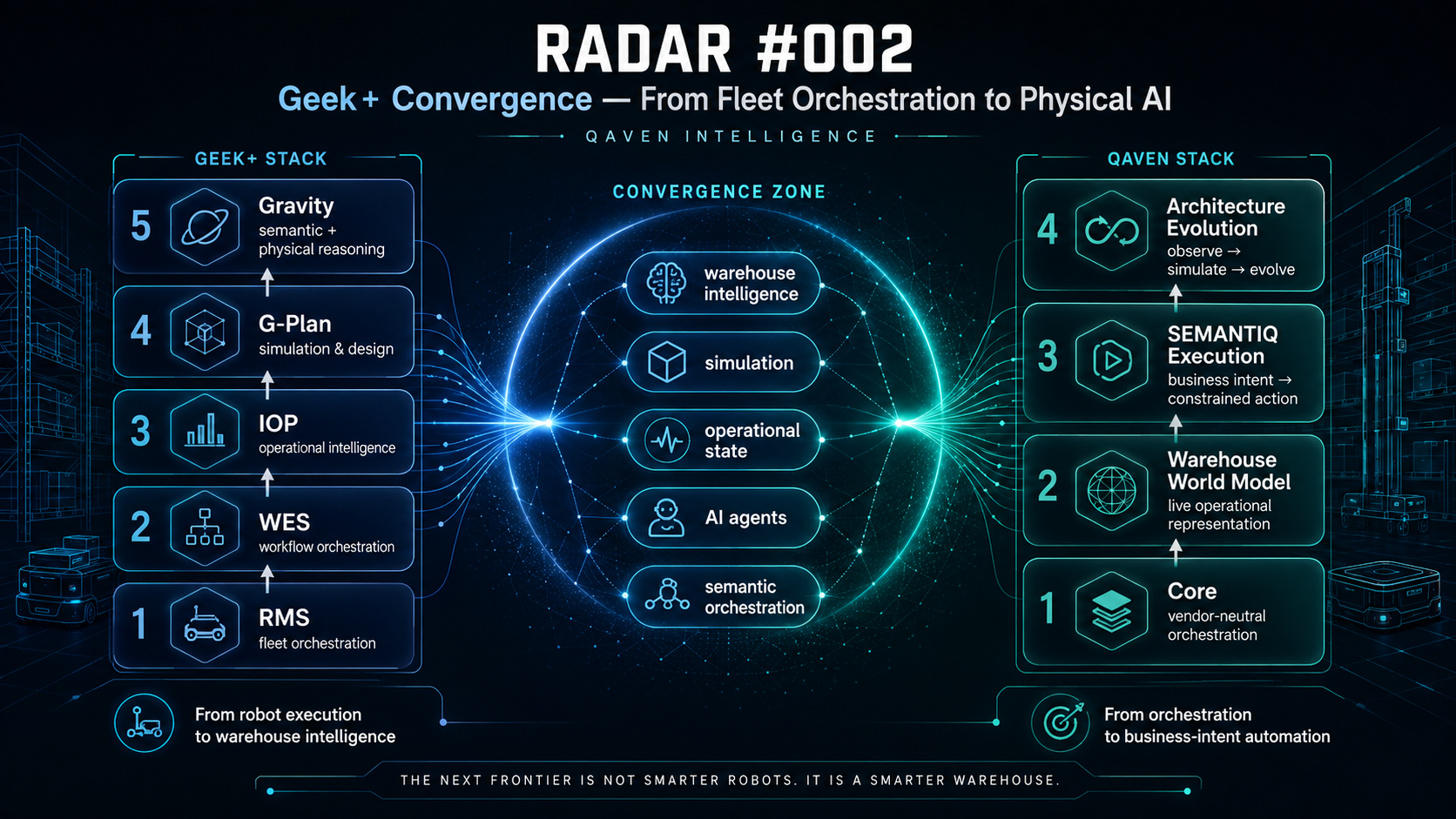
The more important signal is not the speed of a new robot. It is how Geek+ is connecting robot control, warehouse execution, simulation, operational intelligence and embodied AI into one trajectory: RMS → WES → simulation → operational intelligence → AI agents → Physical AI.
That convergence suggests the next competitive frontier may move above individual robots. The question becomes less “How intelligent is the robot?” and more “How intelligent is the warehouse as a system?”
1. Hyper: throughput becomes a concurrency problem
Hyper targets high-flow e-commerce, grocery, cold-chain, consolidation and micro-fulfilment operations. Its meaningful engineering choices are parallel horizontal and vertical movement, concurrent adjacent-column operation, fewer locked columns, two robots in one column, double-deep bidirectional retrieval and two robot aisles beneath one rack.
Geek+ says these choices raise concurrency by 50% and path density by 30% against its stated benchmarks. At scale, throughput depends on available resources × useful concurrency × topology × orchestration quality—not robot speed alone. [S1]
The more concurrency a physical system creates, the more valuable its orchestration layer becomes.
2. The software layer underneath Hyper is already substantial
Geek+ now describes a software architecture beyond fleet management: WES orchestrates workflow, picking, slotting and resource balance; RMS handles large-scale scheduling, path planning and task allocation; IOP provides analytics, alerts and visibility; G-Studio/G-Plan supports planning, simulation and deployment.
The suite connects robotics with ERP, WMS and MES. Geek+ states that RMS can coordinate more than 5,000 robots, process 10,000 tasks per second and use Multi-Agent Path Finding to improve throughput. The important point is that fleet orchestration is itself a major optimization domain. [S6][S7]
3. From robot scheduling to warehouse scheduling
Robot management asks which robot gets a task, which path it takes, how collisions are avoided and when it charges. Warehouse execution asks which orders should be released, which stations receive them, where bottlenecks form and how capacity is balanced across workflows.
IOP exposes processing efficiency, workstation use, inventory, picking, replenishment and robot condition. Geek+ says this data can support order-release, station-assignment and workforce decisions. The architecture is moving from robot state to fleet state to warehouse operational state. [S4]
4. IOP introduces another step: from visibility toward agency
IOP is presently described mainly as operational intelligence, but Geek+'s roadmap says it will integrate AI Agent technologies for autonomous learning, decisions and optimization. [S4]
If implemented deeply, IOP could observe the warehouse, WES could modify workflow and RMS could modify robot execution—forming a closed operational loop. This is a roadmap direction, not yet evidence of one integrated autonomous capability.
5. G-Plan: simulation enters the stack
G-Plan embeds Geek+'s real RMS with a high-fidelity robot-behaviour simulator. Users can compare robot models, RMS versions and warehouse configurations, identify bottlenecks and assess throughput and utilisation. Geek+ says mechanical-efficiency accuracy can exceed 95% for modelled scenarios. [S5]
The warehouse therefore gains a counterfactual environment in which multiple futures can be tested before physical changes are made.
6. But G-Plan reveals an important architectural boundary
Geek+ currently describes G-Plan primarily as a pre-sales design and validation tool: requirements → alternatives → simulation → selection → deployment. [S5]
An emerging industry architecture would connect live operation to a continuously updated warehouse model, simulate alternatives, recommend changes, deploy and learn again. That would move simulation from project design into continuous operation. It is an architectural possibility, not a demonstrated Geek+ loop.
7. Gravity adds semantics — but at a different level
Gravity and the Gravity 4D foundation model combine a Cognitive Brain that interprets instructions and decomposes long tasks with an Action Brain that evaluates physical outcomes and generates actions. [S3]
A Physical-AI world model asks what will happen physically if a robot acts: object, geometry, motion, contact and force. A warehouse operational model asks what will happen if the operation decides: orders, inventory, robots, stations, queues, energy, labour, topology and priorities. Both matter, but they solve different problems.
A Physical-AI world model asks what will happen if a robot acts. A warehouse world model asks what will happen if the operation decides.
8. The convergence is the real story
Seen separately: Hyper is physical automation; RMS is robot orchestration; WES is workflow orchestration; IOP is operational intelligence; G-Plan is simulation; Gravity is semantic and physical reasoning.
Seen together, these layers suggest a path from execution through operational state and counterfactual simulation toward autonomous decisions. No public evidence currently shows all layers operating as one autonomous warehouse-level reasoning loop, but the architectural direction is increasingly visible.
9. Openness matters too
RMS states VDA5050 compatibility, the software suite emphasizes open interfaces, and GINO ECO is intended to connect AI developers, industrial customers and complementary hardware companies. [S3][S7]
Protocol compatibility alone is unlikely to be a durable differentiator. The more consequential question is who remains economically and architecturally neutral when deciding how a heterogeneous warehouse should operate.
Protocol compatibility is not the same as architectural neutrality.
10. The QAVEN view: two semantic boundaries
Physical semantics translates human instruction into a physical task and robot action: identify, grasp, predict interaction and manipulate. Gravity is moving strongly into this domain.
Operational semantics translates business intent into constraints, an operational decision and multi-system execution—for example, reducing priority-order backlog while preserving replenishment service and fleet energy. The robot is only one resource inside that decision.
11. From orchestration to semantic orchestration
First-generation orchestration asks how robots should execute tasks. A more advanced layer asks how all automation resources should achieve an operational objective. A semantic layer asks what the business needs the warehouse to achieve now.
In heterogeneous environments, intelligence must translate intent into constrained, explainable action across robot types, vendors, legacy automation, people, WMS/MES and conveyors. The problem is no longer only route planning.
12. A second frontier: architecture evolution
Operational optimization has limits. Some objectives require more robots, another robot type, chargers, different stations, buffers, zones or storage topology.
The second intelligence problem is knowing when to stop optimizing the current architecture and question the architecture itself. Connecting simulation with live intelligence could create the loop operate → observe → model → simulate → evolve.
13. Why Hyper matters in that context
Hyper's performance comes from coordinated changes to mechanics, rack architecture, movement rules, locking, path density, workstation design and scheduling. Throughput is a system property.
The ceiling increasingly depends not on the intelligence of one machine, but on coordination of the entire cyber-physical environment.
14. What is proven — and what is not
Publicly demonstrated or explicitly stated: large-scale fleet scheduling; WES/RMS/IOP integration; operational analytics; simulation and alternative-design comparison; high-concurrency RoboShuttle architecture; semantic task decomposition; Gravity 4D physical-world modelling; an IOP AI-agent roadmap; and a more open ecosystem. [S1][S3][S4][S5][S6][S7]
Not publicly demonstrated as one integrated capability: natural-language business intent controlling the whole warehouse; semantic reasoning across heterogeneous resources; closed-loop orchestration across business objectives and multiple automation domains; a live Warehouse World Model driving decisions; or automatic architecture evolution from production telemetry. These remain emerging possibilities.
15. The strategic signal for warehouse automation
The sequence is becoming clear: robot automation → fleet orchestration → warehouse orchestration → operational intelligence → simulation → AI agents → semantic reasoning → Physical AI.
The warehouse is moving from machines executing predefined workflows toward a cyber-physical system capable of more sophisticated observation, reasoning and adaptation.
Signal strength: HIGH
RoboShuttle Hyper is significant, but the larger signal is the technology stack forming around it. Geek+ already has robot execution, fleet orchestration, warehouse workflow, analytics and simulation. Gravity adds semantic and physical reasoning; the IOP roadmap adds AI agents.
The remaining architectural gap is the connection at warehouse business-intent level. That gap is likely to attract increasing competition.
The next frontier is not smarter robots. It is a smarter warehouse.
1. IOP + AI Agents
Does AI move from analytics and recommendations into actual WES/RMS decisions?
2. Gravity beyond manipulation
Does semantic reasoning remain focused on embodied tasks, or expand toward warehouse-level planning?
3. G-Plan + live telemetry
Does simulation remain a design tool, or become a continuously calibrated operational digital twin?
4. Multi-vendor execution
Does openness develop into true cross-OEM orchestration in production?
5. Closed-loop architecture optimization
Does Geek+ connect observation, simulation and infrastructure recommendations into one continuous loop?
Hyper points from faster robots toward greater system concurrency. Geek+'s broader trajectory points from fleet orchestration toward warehouse intelligence.
The next frontier may be executing operational intent and continuously adapting the warehouse around it. Competition may increasingly concern who builds the intelligence layer that understands what the warehouse should do next—and why.