VDA 5050 is becoming increasingly important infrastructure for mobile-robot interoperability. Version 3.0.0 expands the interface to better support freely navigating robots and remains explicitly aimed at enabling heterogeneous mobile robots from different manufacturers to work with a fleet control system.
That is real progress.
But a recent practitioner signal from Claus Bedsted of Meili Robots highlights the next problem: two robots can both claim VDA 5050 support and still behave differently when a third-party fleet manager tries to operate them together. Order handling can differ. State reporting can be incomplete. Map handling and error semantics can vary by implementation and firmware.
The implication is not that VDA 5050 has failed.
It is that interface interoperability is only one layer of operational interoperability.
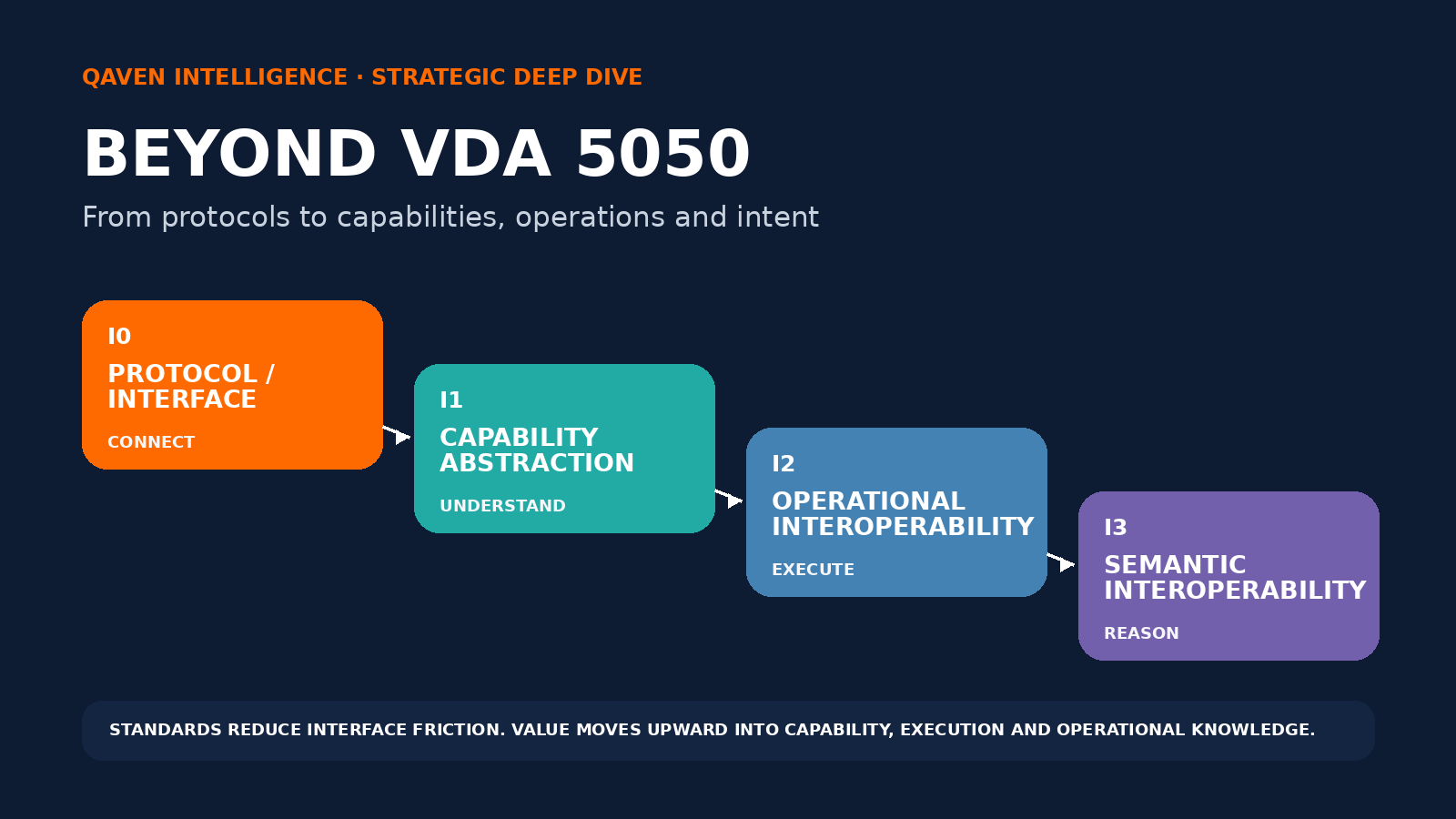
Standards reduce interface friction. They do not remove the need to understand what a resource can do, how it behaves in a shared operating model, and what the operation is trying to achieve.
Deep Dive at a glance
External signal
Nominal VDA 5050 support does not by itself guarantee smooth third-party mixed-fleet integration.
Standard scope
VDA 5050 defines a communication interface for orders, status and related robot/fleet-control exchange; the specification explicitly leaves areas such as traffic-management logic and external-system interfaces outside its scope.
QAVEN interpretation
Interoperability is a stack: protocol/interface → capability abstraction → operational interoperability → semantic interoperability.
Architecture implication
Vendor and protocol specifics should terminate below a canonical deterministic Core boundary. Higher reasoning should operate on governed capabilities, state, missions and constraints rather than directly on vendor APIs.
1. The signal: compliance is not the same as interoperability
Bedsted’s post describes a familiar integration pattern. Multiple vendors can be technically compliant with the same standard while real mixed-fleet deployment still exposes differences in order processing, state reporting, maps, errors and firmware-specific behavior.
This is a useful distinction for operators.
The procurement question should not stop at: “Does this robot support VDA 5050?”
It should continue with: “Has this robot been integrated with an independent fleet manager, and what had to be resolved before it worked reliably?”
That second question moves from nominal interface support toward operational evidence.
This matters because heterogeneous fleets are no longer a theoretical edge case. Operators increasingly want the freedom to combine robot classes, vendors and generations without rebuilding warehouse logic around every hardware decision.
2. What VDA 5050 solves — and what it deliberately does not
The current VDA 5050 specification has a clear and valuable objective: reduce complexity when connecting mobile robots to fleet control and enable coordinated operation of heterogeneous mobile-robot fleets.
Version 3.0.0 also makes the boundary more sophisticated. It adds mechanisms for higher-autonomy robots, including zone concepts and path sharing, while preserving established approaches for other robot types.
The standard also includes a machine-processable factsheet. The factsheet can describe basic physical and functional information about a robot type and is intended to support comparison, planning, dimensioning, simulation and integration.
But the standard is not a complete warehouse operating system.
Its own scope explicitly excludes, among other things, safety requirements, traffic-management logic and interfaces to external IT or peripheral systems.
A standard can define how information crosses a boundary without defining the complete operational meaning of that information inside a warehouse.
3. Interoperability is a stack
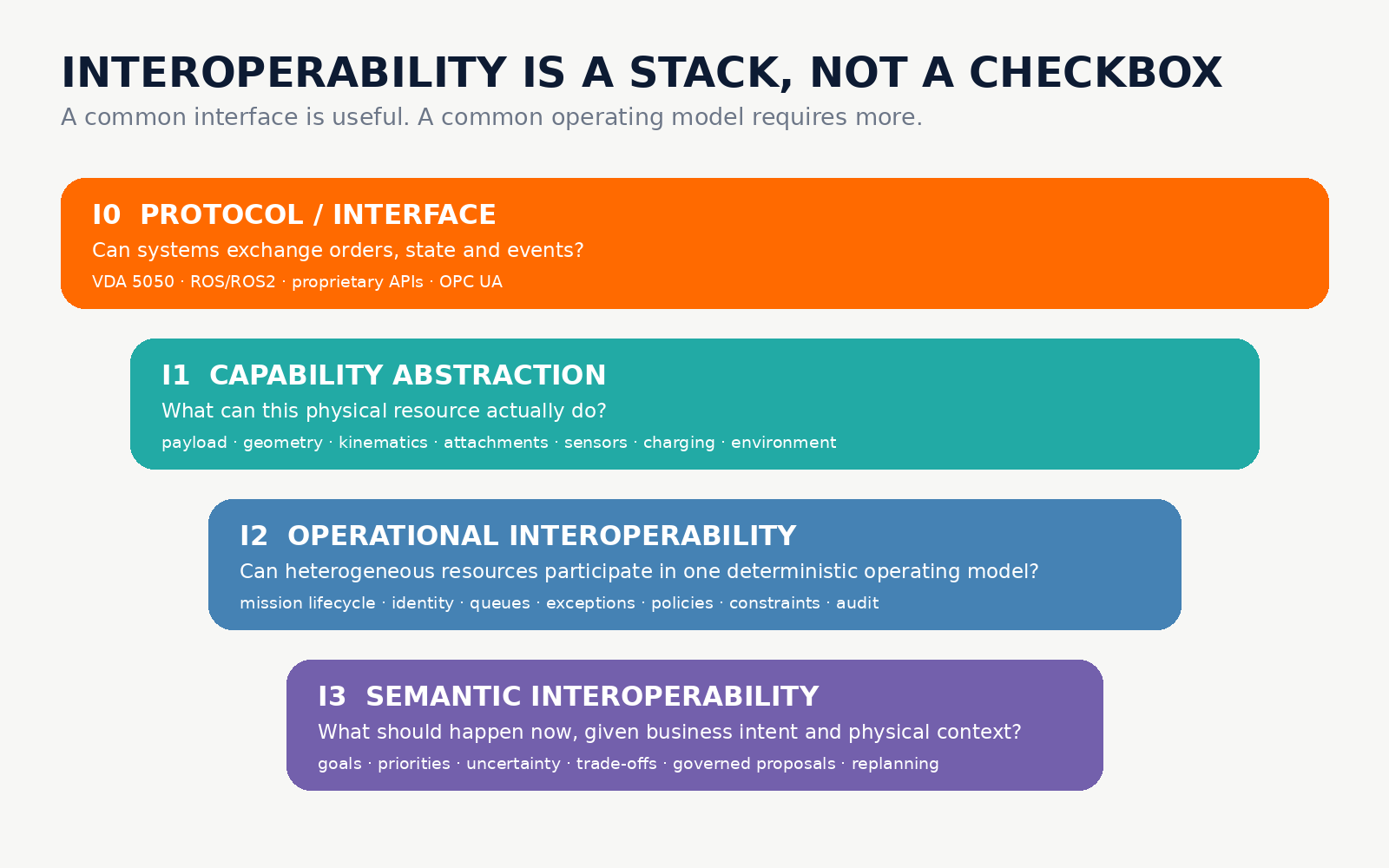
We think it is useful to separate four layers.
I0 — Protocol / interface interoperability
Can systems exchange orders, state and events?
This is the territory of VDA 5050, ROS/ROS2, proprietary APIs, OPC UA and other interfaces. Standards matter because they reduce integration cost, make interfaces more explicit and lower the amount of proprietary plumbing required for every deployment. But connectivity is the beginning of interoperability, not the end.
I1 — Capability abstraction
What can this physical resource actually do?
A vendor-neutral operating layer needs a consistent representation of properties such as payload, geometry, kinematics, load handling, attachments, sensors, charging behavior, navigation modes and environmental limits. VDA 5050’s factsheet can provide part of that information for compatible mobile robots. Other resources may expose it through other protocols, configuration sources or integration contracts.
The key architectural principle is that the warehouse operating model should not depend on one protocol as the definition of the resource.
I2 — Operational interoperability
Can heterogeneous resources participate in the same deterministic warehouse process?
This is harder than exchanging messages. It requires common mission lifecycles, identity, queues, exception semantics, policies, constraints, auditability and recovery behavior.
The objective is not to pretend every robot is identical. It is to make the relevant differences explicit and manageable without rebuilding upstream business logic around every vendor.
I3 — Semantic interoperability
What should the operation do now, given business intent and physical context?
Once capabilities and operational state are represented consistently, a higher layer can reason over goals, priorities, constraints, uncertainty and trade-offs. That is where semantic execution becomes possible: not replacing deterministic control, but raising the interface from individual robot commands toward operational intent.
4. The important abstraction is effective capability
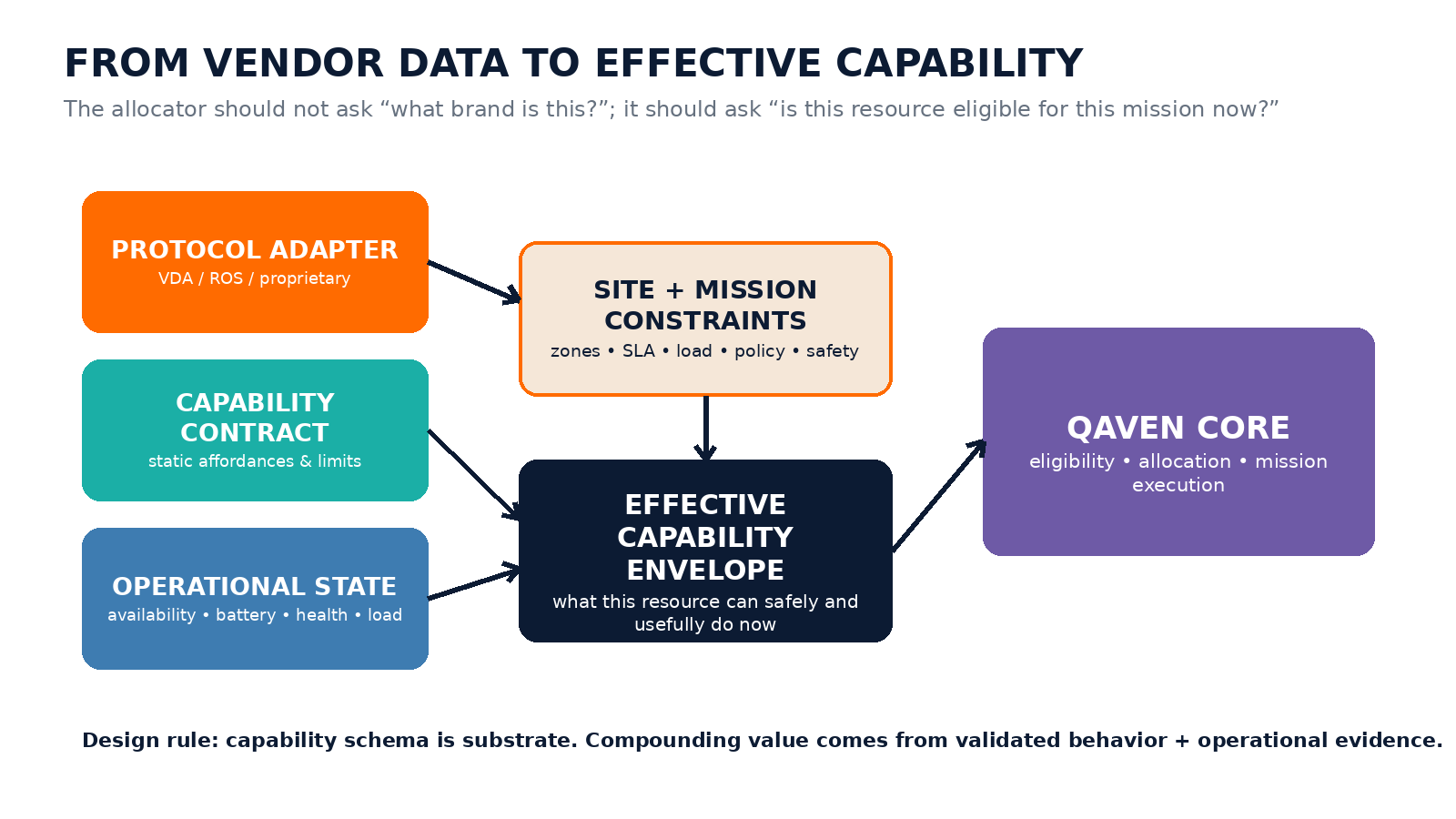
A nameplate specification is not the same as what a physical resource can safely and usefully do right now.
A nominal payload may be filtered by current battery state, attachment availability, a temporary zone restriction, floor conditions, mission length, maintenance state or an operational SLA.
For allocation purposes, the useful question is therefore not simply: “What is this robot?” It is: “Is this resource eligible for this mission now?”
Declared capability ∩ current operational state ∩ site constraints ∩ mission constraints = effective capability envelope
This layer should remain deterministic. An AI system may reason about priorities or alternatives, but it should not invent physical affordances, bypass hard limits or redefine safety constraints.
5. What this means for QAVEN Core
QAVEN Core is being designed as the deterministic execution and orchestration layer across heterogeneous automation.
The interoperability thesis sharpens its boundary. Vendor and protocol specifics should terminate below a set of canonical operational contracts, including:
- capability contract;
- operational state model;
- action / mission vocabulary;
- identity and lifecycle model.
Above that boundary, mission logic should work with stable operational concepts rather than vendor-specific APIs whenever the physical differences do not matter to the process.
That makes hardware substitution a question of validated capability and behavior — not merely of protocol compatibility.
This is also where implementation evidence becomes important. A schema may say that two resources expose equivalent capabilities. Production evidence determines whether they actually execute equivalent missions reliably under the relevant site constraints.
6. Why SEMANTIQ is a separate layer
SEMANTIQ sits above the deterministic execution boundary in QAVEN’s target architecture.
Its role is not to become a natural-language remote control for robots.
Its target role is to reason over operational meaning:
- the business objective;
- priorities and policies;
- the state of the warehouse;
- effective capabilities of available resources;
- constraints and uncertainty;
- alternative ways of achieving the required outcome.
SEMANTIQ can then submit governed, typed proposals back to deterministic Core for validation and execution.
Protocols connect resources.
Capabilities describe resources.
Core makes them operationally usable within a common deterministic model.
SEMANTIQ reasons over what the operation is trying to achieve.
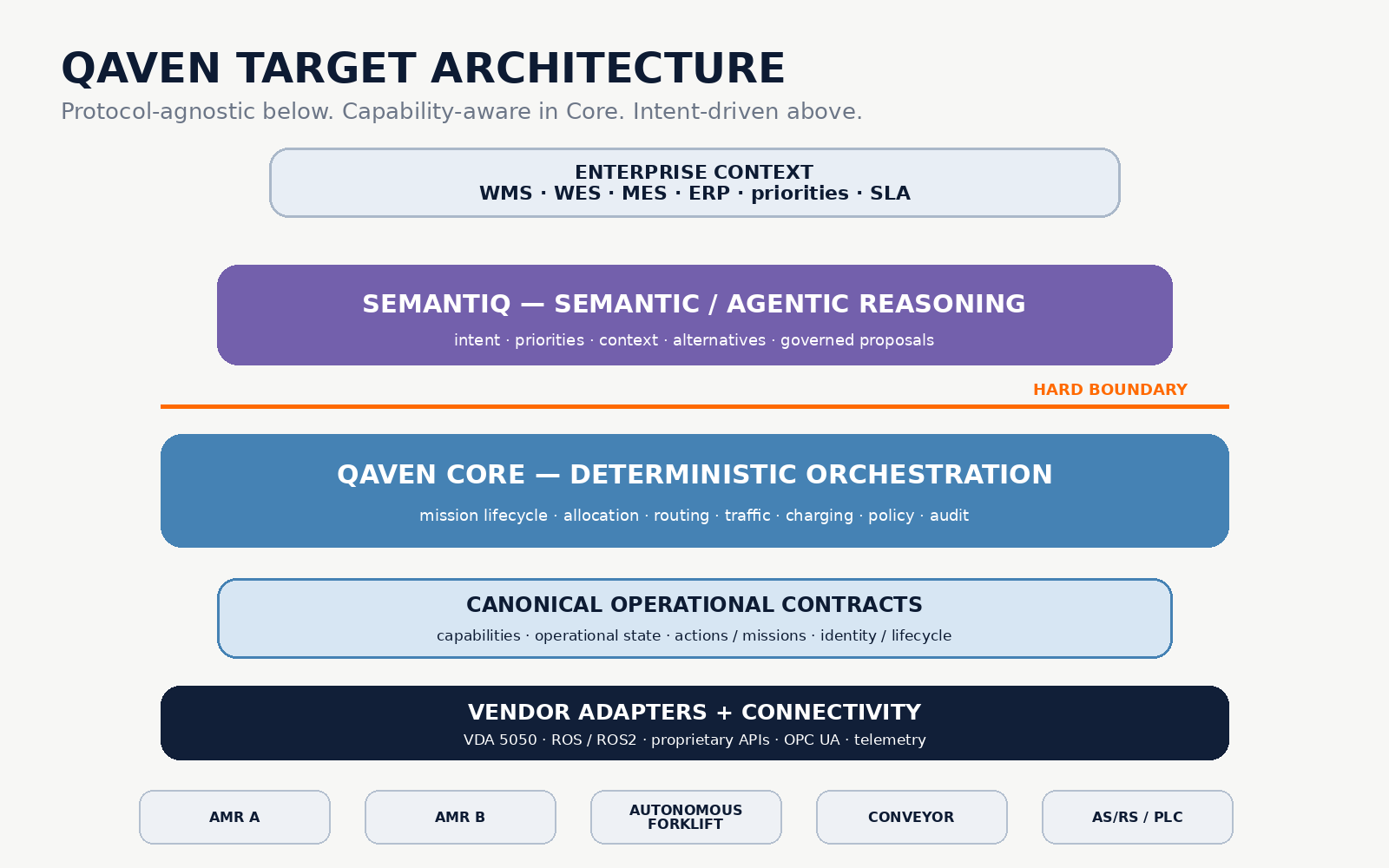
QAVEN architecture shown here is target / working architecture, not a claim that every described capability is already production-complete.
7. The competitive implication: capability abstraction is category architecture, not the moat
The need for an independent multi-vendor fleet layer is already visible in the market.
Meili Robots, for example, documents integrations through VDA 5050 as well as other robot interfaces, and its public documentation describes traffic control across robots from multiple vendors.
That is useful validation for the category. It also means QAVEN should not claim differentiation from simply supporting multiple protocols or having a capability model. Those are necessary architecture.
The more interesting compounding asset is the operational evidence built above the schema:
- which capabilities have been validated against which missions;
- which firmware / adapter versions produced which behavior;
- what exceptions and recovery patterns appeared;
- which site constraints materially changed effective capability;
- how heterogeneous resources performed inside a common operational lifecycle;
- what execution outcomes can be replayed, simulated and compared.
That turns interoperability from a checklist into reusable operational knowledge.
8. What would prove the thesis?
The architecture should be tested through evidence, not diagrams.
A meaningful QAVEN interoperability test would demonstrate:
- two robot vendors connected through different or differently implemented interfaces;
- both mapped into the same canonical operational contracts;
- mission allocation based on effective capability rather than vendor identity;
- upstream process logic remaining stable when a physical resource changes;
- conformance and failure behavior captured as reusable evidence;
- SEMANTIQ reasoning above the deterministic boundary without direct uncontrolled robot access.
These are stronger tests than showing that two robots can appear on one dashboard.
Bottom line
VDA 5050 should make QAVEN easier to build, not unnecessary.
The better interoperability standards become, the less value there is in proprietary message plumbing. That is good for operators — and good for an architecture that wants the physical layer to remain replaceable.
But value does not disappear. It moves upward:
from protocol compatibility → to capability normalization → to deterministic operational interoperability → to accumulated execution evidence → and eventually to semantic reasoning over the physical operation.
The future mixed warehouse does not need every robot to become the same machine. It needs an operating layer that understands their differences without allowing those differences to dominate the warehouse architecture.