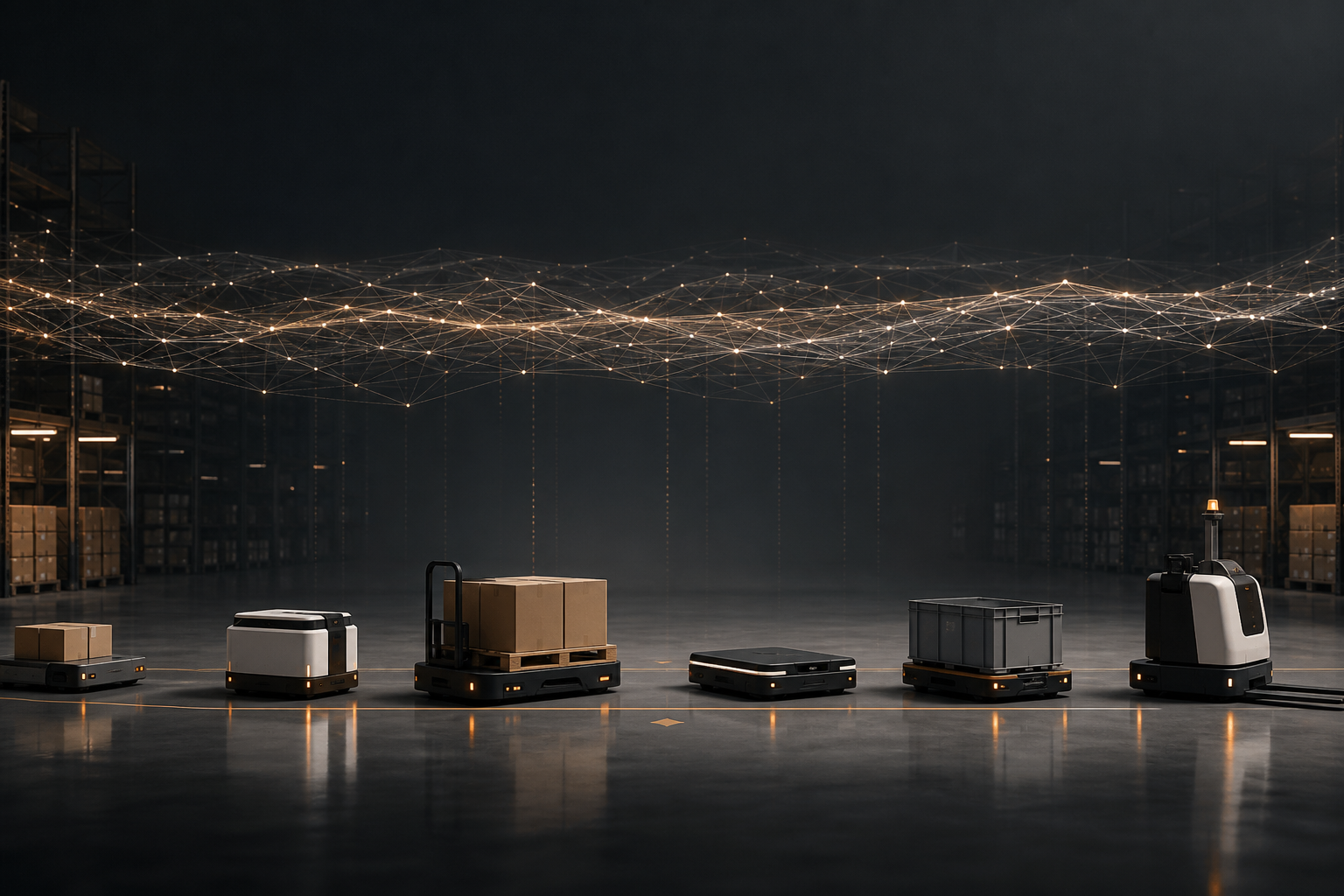
Robots may become replaceable. The warehouse knowledge above them should not.
For years, robotics platforms have treated the robot as the central unit of automation.
That assumption is beginning to change.
As more vendors deliver comparable physical capabilities, enterprises will increasingly operate heterogeneous robotic fleets. The relevant question becomes less which robot performs the task? and more:
What capability does the operation require — and which available resource should provide it?Beyond VDA 5050 → Why protocol compatibility is only the first layer of making heterogeneous resources operationally interchangeable.
A recent b2venture thesis by Anna Bosch describes this transition from heterogeneous fleets toward persistent operational knowledge layers. We believe it points to an even larger shift: the emergence of an intelligence layer between business intent and physical execution.
From robots to capabilities
When only one machine can perform a task, the machine defines the workflow. When several machines can perform it, the machine becomes an implementation choice.
The persistent object becomes the capability: transport · pick · sort · inspect · replenish — combined with constraints such as time · load · cost · safety · availability · SLA.
The physical robot still matters. But it increasingly becomes one possible implementation of a required operational capability.
Heterogeneity changes the problem
Multi-vendor robotics is often framed as an integration challenge. But once robots, fixed automation, infrastructure and people participate in the same workflow, integration is only the beginning.
The harder problem lies between systems: dependencies · task allocation · traffic · exceptions · priorities · resource conflicts · changing operating conditions.
Industry standards are already making the lower layers more interoperable. VDA 5050 v3.0, for example, is designed to let different mobile robots operate under a common master control. As connectivity becomes easier, differentiation can move upward — toward the logic that understands the operation as a whole.
Orchestration can become memory
An orchestration layer sees something no individual robot sees: the complete operation over time.
- which workflows succeed;
- where congestion forms;
- which exceptions repeat;
- which capabilities perform best under particular conditions;
- how changes propagate through the physical process.
The important consequence is persistence. A robot may leave the fleet. Its accumulated operational context does not have to leave with it.
hardware changes; operational knowledge compounds.
QAVEN view: orchestration is not the endpoint
A knowledge layer can describe what happened. A World Model can represent what exists now — resources, capabilities, topology, workflows, constraints, state and outcomes.
An intelligence layer can begin asking:
Given this business objective, these constraints and the current physical environment — what should happen next?
And eventually:
Is the existing physical system itself sufficient?
That is where execution begins to merge with simulation and system evolution.
From execution to evolution
Execution
Increase replenishment priority for the next two hours without violating outbound SLA.
The system should use the capabilities already available.
Evolution
Can this operation support 35% more throughput next year?
Now the answer may involve more robots, different robots, different task allocation, charging changes, layout changes or workflow redesign.
The same operational model that controls today's warehouse can potentially become the foundation for simulating tomorrow's warehouse.
The long-term value of robotic orchestration may not come from controlling more robots. It may come from retaining more operational intelligence as the robots underneath it change.
The winning abstraction may therefore be neither the robot nor even the fleet. It may be the persistent model of physical work itself.
Interoperability
Standards and open interfaces reduce the cost of changing hardware.
Capability convergence
More OEMs become capable of producing equivalent business outcomes.
Knowledge transfer
Operational learning from one machine, workflow or site begins improving another.
Robots change. Operational intelligence persists.