Thin software layers can be squeezed as suppliers integrate upward.
Robot OEMs are expanding into WES, orchestration, simulation and enterprise integration.
The robot-to-master-control boundary is becoming more specifiable through interoperability standards.
The next unstable interface may be moving upward toward warehouse-level reasoning.
Full-stack warehouse intelligence over modular physical infrastructure.
Francesco Ricciuti’s “Robotics companies should go full-stack” challenges a common assumption: buy capable hardware, focus on software and let suppliers carry manufacturing complexity. His warning is difficult to dismiss. A supplier can move from chassis to sensors, navigation, fleet software and a complete robot until the startup is left with deployment and integration. [S1]
That risk is visible in warehouse automation. Hikrobot combines iWMS and RCS; HAI Robotics’ HaiQ spans WES, scheduling, data, simulation and algorithms; Geek+ describes an end-to-end WES, RMS and IOP suite. [S5][S6][S7]
Vertical integration matters. The question is around what the next warehouse-automation company should integrate. QAVEN’s answer: warehouse intelligence, not the robot chassis.
1. The warning is real: thin software layers get squeezed
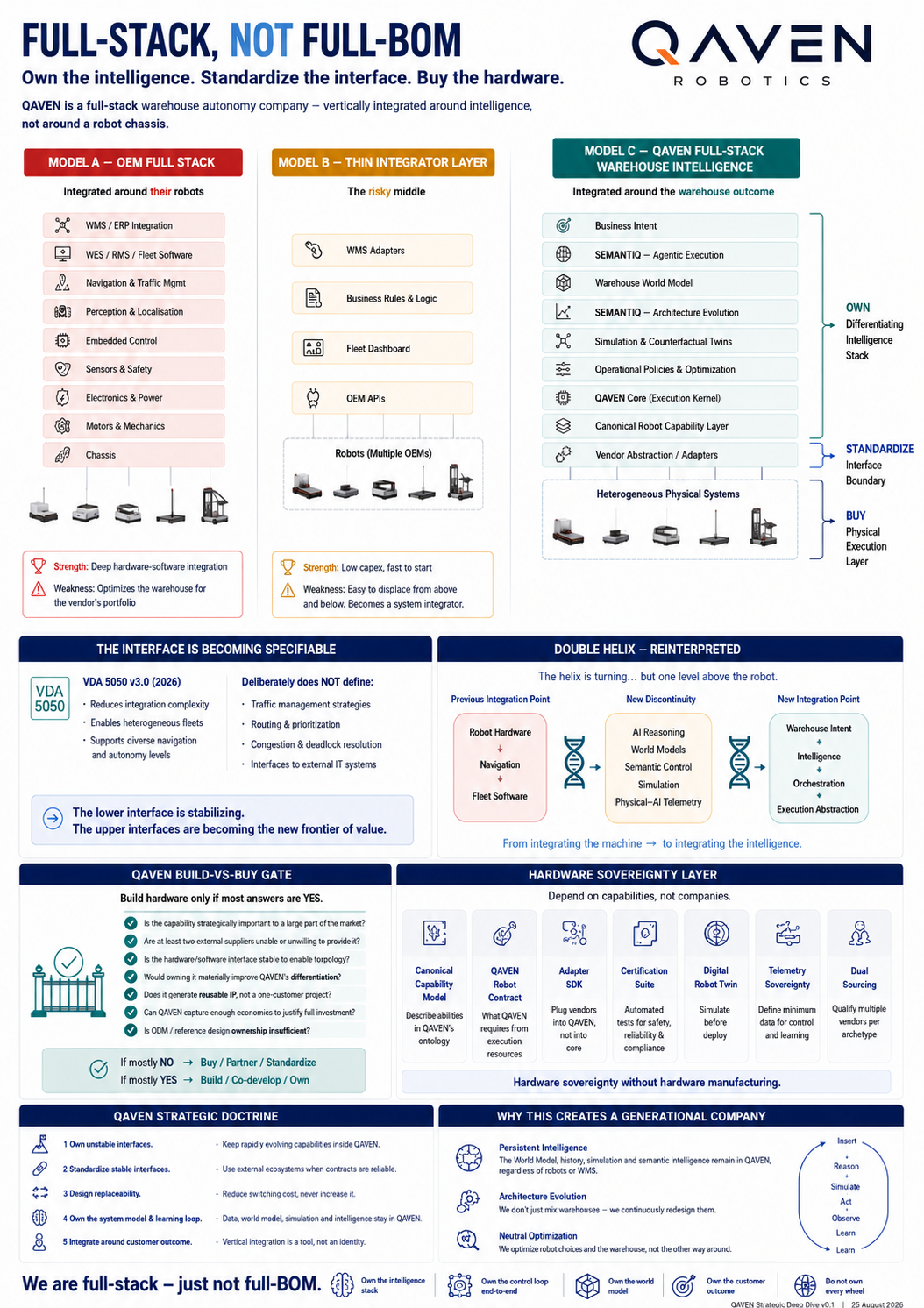
The weakest software-defined robotics stack is WMS adapters → business rules → fleet dashboard → OEM APIs → robots. OEMs can move upward, enterprise platforms can move downward, standards can cheapen adapters and project engineering can consume the business.
Hikrobot already spans warehouse logic, dispatch, task allocation, planning and traffic. HaiQ includes WES, equipment scheduling, data, simulation and algorithms. Geek+ unifies design, control and execution. A multi-vendor fleet manager that stops in the middle is not automatically defensible. [S5][S6][S7]
robot → fleet software → warehouse execution → simulation → operational intelligence
2. But “full-stack” and “full-BOM” are not the same strategy
Vertical integration is too often framed as build the robot or become an integrator. A company can integrate around the customer outcome without manufacturing every physical subsystem.
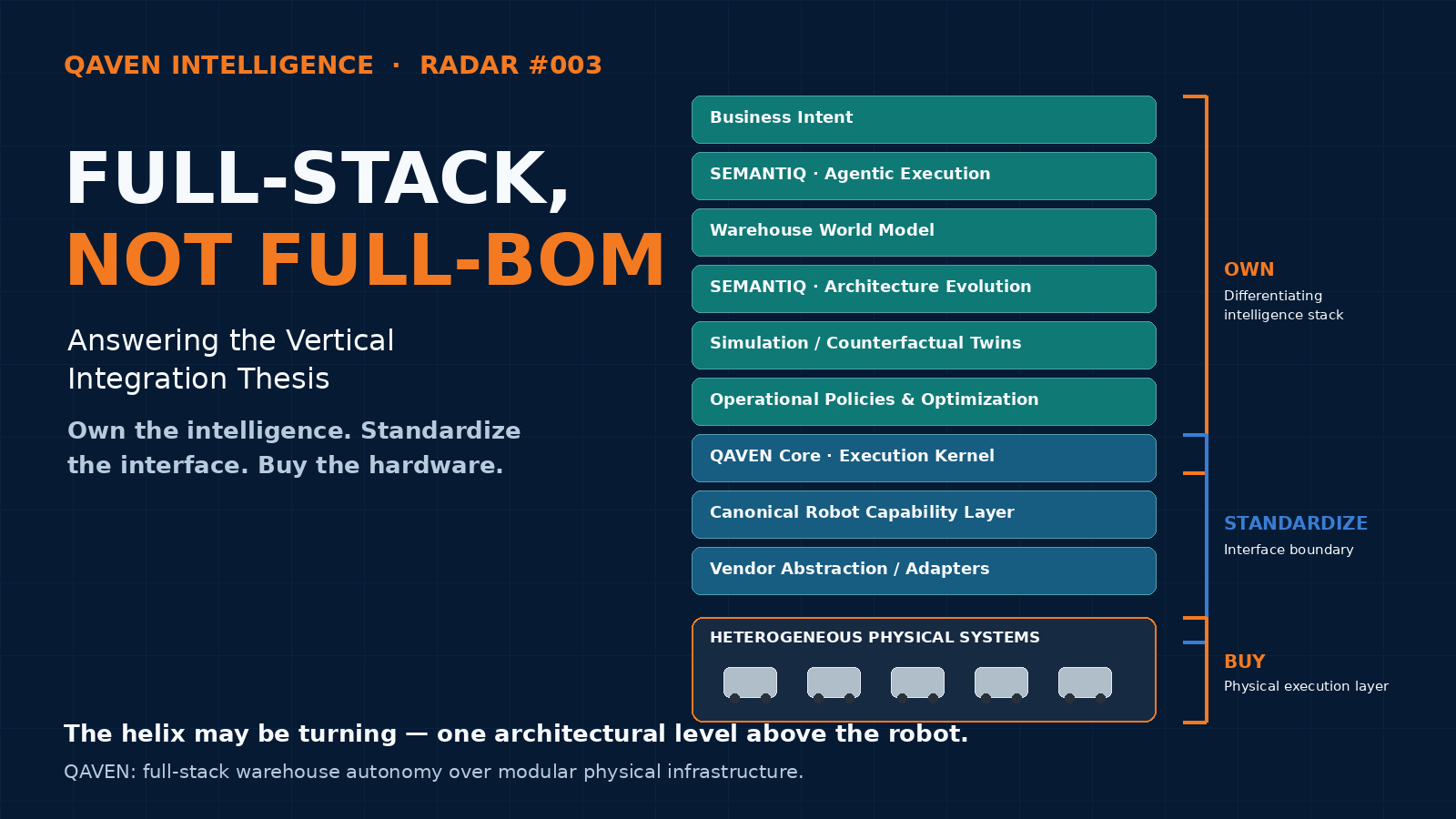
A robot-centered stack rises from hardware through navigation and embedded control to fleet and warehouse software. A warehouse-centered stack descends from business intent through semantics, a Warehouse World Model, reasoning, simulation and orchestration to capability abstraction and heterogeneous physical systems. QAVEN is pursuing the second.
QAVEN VIEW — A company can be full-stack without being full-BOM.CASE EVIDENCE →Walmart × KNAPP — From Integrated Automation to Intelligent OrchestrationSee how integrated site automation, operator-level vendor abstraction and warehouse software appear together in a real-scale fulfillment architecture.
3. The “double helix” can turn one level above the robot
Ricciuti’s Double Helix says young industries integrate while interfaces are unstable, specialize as interfaces mature, and reintegrate after discontinuity. The disagreement is where the new instability sits. [S1]
At the robot boundary, VDA 5050 v3.0 makes communication with master control more explicit and supports heterogeneous fleets and more autonomous navigation. MassRobotics defines shared location, speed, health and tasking data. These efforts do not make robots equivalent, but make more of the boundary describable through a contract. [S2][S3][S4]
Meanwhile, AI reasoning, world models, digital twins and closed-loop optimization destabilize the upper boundary. The helix may be turning one architectural level above the robot.
More of the robot boundary can be described through a contract.
4. Refine the shorthand: from “commodity” to “substitutable”
QAVEN’s earlier shorthand—robots are becoming commodities—was directionally useful but too broad literally. Hardware still differs materially in reliability, payload, safety, navigation, serviceability and economics.
Commodity describes a product. Substitutable describes system architecture. A sophisticated robot becomes substitutable when Vendor A can be replaced by Vendor B without rewriting warehouse logic, rebuilding the world model or surrendering operational history.
The QAVEN foundational thesis is updated in place: robot hardware is becoming increasingly substitutable. We do not need robots to become simple; we need them to become replaceable execution resources.
Robot hardware is becoming increasingly substitutable.QAVEN THESIS 01 →
5. QAVEN’s integration boundary
OWN the evolving intelligence stack: business-intent interpretation, SEMANTIQ Agentic Execution, Warehouse World Model, Architecture Evolution, counterfactual simulation, operational policies, QAVEN Core’s execution kernel and the canonical capability model.
STANDARDIZE the physical boundary: vendor abstraction, adapter contracts, VDA 5050 where appropriate, certification, telemetry requirements and digital twins.
BUY / PARTNER where interfaces are stable: chassis, motors, batteries, commodity sensors, safety hardware, manufacturing and complete AMR platforms. This is deliberate allocation of ownership, not anti-hardware ideology.
Own the unstable interfaces. Standardize the stable ones.Beyond VDA 5050 → A deeper look at the boundary between protocol standards, capability contracts and deterministic orchestration.
6. Why SEMANTIQ changes the equation
Without a higher intelligence layer, WMS → orchestration → OEM adapters → robots is vulnerable to pressure from OEMs, enterprise platforms and standards.
With business intent → SEMANTIQ → Warehouse World Model → simulation → QAVEN Core → vendor-neutral execution, the center moves above fleet dispatch. Agentic Execution asks what the operation should do now; Architecture Evolution asks whether the physical architecture remains the best way to meet the objective.
These are target architectural capabilities, not claims of production proof. Their strategic value is neutrality: an independent layer can in principle recommend a mixed architecture rather than optimize around one product portfolio.
Robot OEMs optimize the warehouse around their robots. QAVEN aims to optimize robots around the warehouse.
7. Hardware Sovereignty without a robot factory
Using APIs is not enough. QAVEN needs a Hardware Sovereignty Layer built on a canonical robot capability model, a vendor-independent Robot Contract, an Adapter SDK, certification, a Digital Robot Twin, telemetry sovereignty and practical dual sourcing.
This means describing payload, footprint, motion, charging, load actions, safety states, telemetry and restrictions in QAVEN’s ontology; testing execution and recovery repeatably; and retaining the operational data required to observe, explain and learn.
Depend on capabilities, not companies.
8. When should QAVEN actually build hardware?
Full-stack, not full-BOM is not a promise never to build hardware. Building becomes rational when the capability matters broadly, suppliers cannot provide it, the interface is too unstable to specify, ownership materially improves differentiation, reusable IP results, economics justify the lifecycle and an ODM route is insufficient.
If most answers are no, buy, partner or standardize. If most become yes, build, co-develop or own. Vertical integration is a tool, not an identity.
9. What would prove the strategy?
The thesis must be tested operationally. A QAVEN sandbox should show two vendors executing through one capability model; hardware replacement without changing upstream logic; rapid adapter certification; vendor-independent SEMANTIQ reasoning; digital-twin comparison of alternatives; heterogeneous recommendations when superior; and telemetry retained by the warehouse intelligence layer.
These are architecture tests, not demo tests—and directly address the risk identified by the vertical-integration thesis.
Signal strength: HIGH
The full-stack argument identifies a real failure mode: outsourcing every difficult layer can leave a robotics software company owning integration work. OEM expansion makes the risk concrete, while interoperability standards make the robot boundary more explicit. [S1]–[S7]
Our interpretation is architectural: the differentiating stack is moving upward. A next-generation warehouse company can integrate across the intelligence loop while treating physical execution as modular infrastructure.
FULL-STACK, NOT FULL-BOM.
1. VDA 5050 v3 adoption
Does v3 become practical infrastructure for heterogeneous fleets and more autonomous navigation?
2. Cross-OEM control depth
Do multi-vendor systems gain the telemetry and control depth required for optimization and learning?
3. OEM software expansion
How far do OEMs move from RMS/WES into simulation, business-intent reasoning and architecture decisions?
4. World-model ownership
Does the warehouse model live with the OEM, WMS/WES, an independent control layer—or a combination?
5. Architecture optimization
Do digital twins become continuously calibrated systems that recommend changes to fleet, layout and policy?
The vertical-integration thesis deserves a better question than whether every component should be built internally: where is the unstable interface that will define strategic control?
QAVEN’s answer is one level above the robot: Intent → World Model → Reason → Simulate → Orchestrate → Execute → Learn. Own that loop, standardize the boundary below it and use the best physical execution available.