Enterprise AI is moving closer to operational decisions while warehouse robotics platforms are moving upward into orchestration, execution software and Physical AI. The gap between those two movements may become one of the most important control points in the next warehouse software stack.
Enterprise AI is moving down. Robotics intelligence is moving up. The strategic control point is forming where business intent becomes physical action.
1. Two parts of the stack are converging
For years, enterprise planning and warehouse automation evolved largely as separate software domains. ERP, supply-chain planning and WMS platforms decided what needed to happen. Robots, conveyors, AS/RS, PLCs and fleet managers decided how equipment should move.
That separation is becoming less stable. Planning platforms are becoming AI-native, more real-time and increasingly agentic. Warehouse automation vendors are expanding into WES, orchestration, simulation, operational intelligence and Physical AI.
Who translates enterprise intent into coordinated physical execution?
Four recent signals make that question more concrete.
2. Signal from above: Dollar General × RELEX
Dollar General is deploying RELEX forecasting, replenishment and allocation across more than 21,000 stores, 34 distribution centers and roughly 18,000 SKUs. The important point is not simply another AI forecasting deployment. The platform is intended to coordinate replenishment, ordering schedules, lead times, supplier coordination and fulfillment methods inside one planning environment.
Dollar General CEO Todd Vasos has also said the company is building “agentic operating systems for the enterprise” to reshape and optimize workflows. The direction is forecasting → planning → operational decisions → agentic workflows.
But an intelligent planning layer still reaches a physical boundary: which resources perform the work; how robots, stations and people coordinate; how charging, congestion or failures alter capacity; and how priorities change without violating safety or operational constraints.
3. The Intel readiness gap: adoption is moving faster than the operating model
Intel’s 2026 Robotics Readiness Gap surveyed 800 senior leaders and specialists across six countries and organizations with annual revenue of at least $500 million.
- 6 in 10 expect their organization to operate a robot fleet within five years.
- Only 40% currently have a formal human-robot workforce strategy.
- 74% believe workforce planning and robotics strategy will become inseparable by 2030.
- 42% already have a funded edge or on-device AI strategy for robotics, with another 39% developing one.
Integration with existing systems is the second-ranked blocker after upfront CAPEX, AMRs are the robot category expected to have the greatest impact, and more than three-quarters say critical robotic decisions must occur within 100 milliseconds. The gap is therefore an operating-architecture gap, not only a shortage of robots or AI models.
4. Signal from below: Walmart × KNAPP
Walmart’s Next Generation Fulfillment Centers built with KNAPP reduced a 12-step manual process to five software-supported steps and doubled orders processed per day. KNAPP’s 2026 outlook moves beyond isolated automation toward interconnected systems that prepare decisions, set priorities and execute parts of daily operations.
KNAPP explicitly describes AI-driven orchestration and interoperability between robots from different systems and manufacturers: machine control → fleet control → WES → orchestration → operational intelligence.
Walmart × KNAPP — From Integrated Automation to Intelligent Orchestration →5. Geek+ shows how far an OEM stack can move upward
Geek+ combines RMS, WES and an Intelligent Operations Platform, while RS Hyper is designed to coordinate configurations of up to 5,000 robots. At WAIC 2026, Geek+ introduced its Gravity embodied-AI framework and described large-scale multi-robot orchestration as a native capability of future embodied systems.
This reinforces the view that orchestration is becoming increasingly strategic—and warns independent software companies that robot OEMs are moving upward into control, WES, operational data and intelligence.
Geek+ Convergence — From Fleet Orchestration to Physical AI →6. The missing layer
Put the four signals together and the white space becomes easier to see. It is not simply another fleet manager. It is the layer that can answer: given the current business objective, constraints and warehouse state, how should the physical operation achieve the required outcome now—and what should change if the current configuration cannot achieve it reliably?
Proposed architecture, not a claim that every capability is already production-complete.
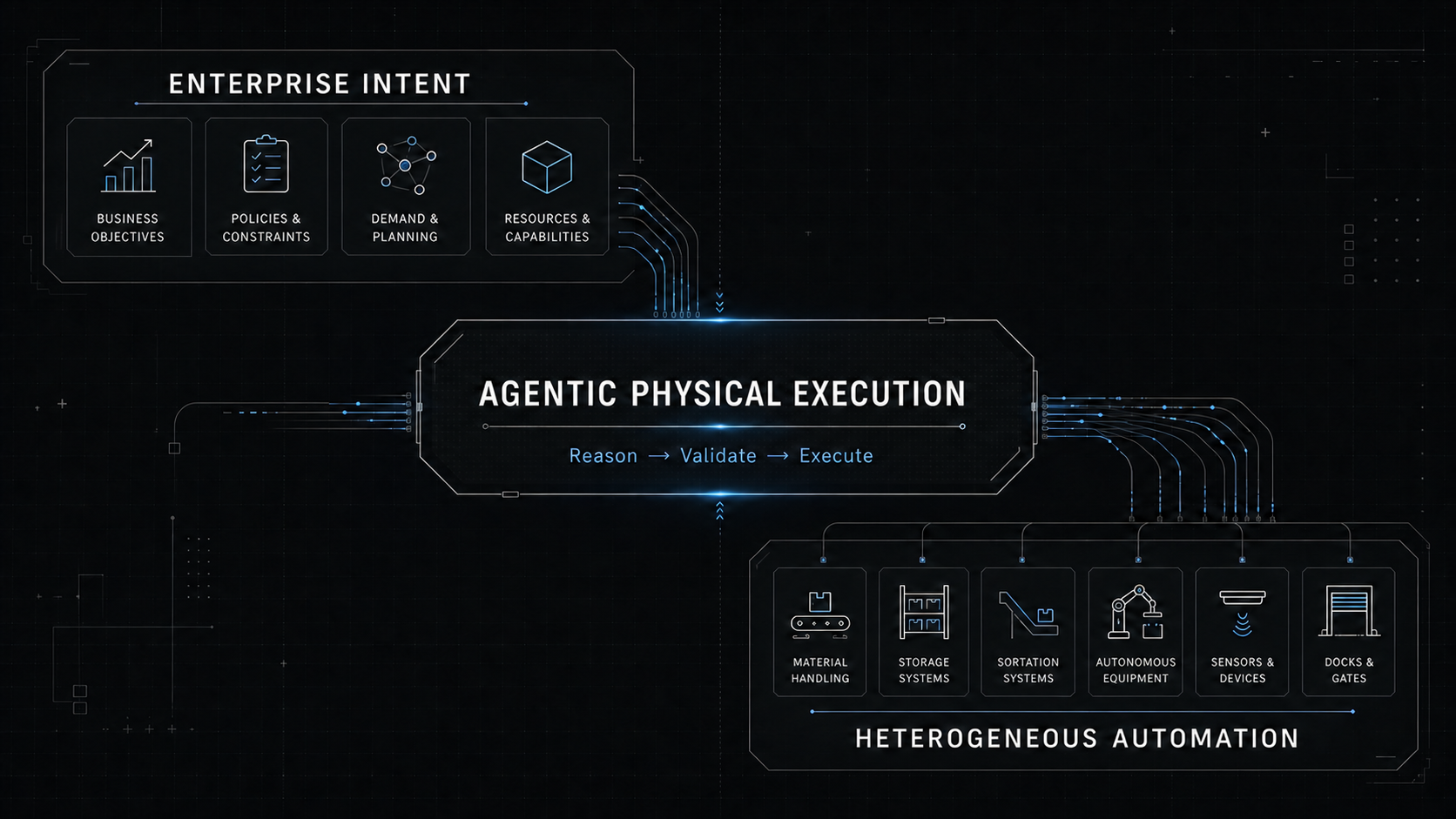
7. The QAVEN thesis: agentic physical execution
QAVEN’s architecture thesis is that this emerging control point should remain independent of any single robot vendor.
SEMANTIQ — reasoning above execution
SEMANTIQ is the proposed intent and reasoning layer. Its target role is to work with objectives, priorities, constraints and warehouse state; compare alternative execution policies; use a Warehouse World Model and simulation; and explain why a policy should be chosen.
QAVEN Core — deterministic execution below reasoning
QAVEN Core provides the deterministic execution substrate: missions, process logic, resource allocation, routing, traffic, adapters, operational state and hard execution boundaries.
SEMANTIQ reasons. QAVEN Core guarantees.
An AI agent should not directly drive a robot through a vendor API. It should operate above a controlled execution plane that validates actions against physical, operational and safety constraints. This is a proposed target architecture, not a claim that every described SEMANTIQ or World Model capability is already fully productized.
Beyond VDA 5050 → How vendor protocols terminate at capability-aware deterministic execution before reasoning moves upward.The Orchestration Gap Is Still Open →
8. From robot APIs to an Intent API
Traditional integration is dominated by tasks such as move load X to location Y. An agentic execution layer should increasingly accept intent:
Goal:
Complete priority replenishment before 04:30.

Constraints:
- protect priority-store SLA
- do not increase shift labor
- preserve charging reserve
- avoid unsafe congestion

Objective:
Minimize expected completion time.
The execution system must translate that goal into a physically valid plan using resources actually available. This is a different abstraction layer from a robot API or traditional mission queue.
9. Simulation becomes part of the runtime architecture
A digital twin is often treated as a pre-deployment planning tool. In an agentic execution architecture, simulation can become part of a live loop: observe → model → simulate alternatives → validate policy → execute → learn.
If planning predicts a 17% next-day demand increase, the physical execution layer should determine whether the current configuration can absorb it and compare wave sequencing, fleet reallocation, workstation reassignment, charging-policy changes, temporary capacity additions and later topology changes.
10. Why vendor neutrality becomes strategic
The next-generation argument is stronger than connecting several robot brands: enterprise intelligence should not become coupled to one physical automation vendor.
That requires a canonical capability model, deep integration with physical constraints, reusable execution logic, operational telemetry and a persistent representation of warehouse state. The valuable abstraction is the capability to perform physical work regardless of which compatible resource provides it.
When Robots Become Replaceable — RADAR #004 →11. What the market signals do—and do not—prove
These developments do not prove that a new software category is already established, or that one independent control layer will win it. They show a consistent directional pattern:
- planning platforms are moving toward more autonomous operational decisions;
- robot vendors are moving upward into WES, orchestration and Physical AI;
- robot adoption is accelerating faster than enterprise operating models can absorb it;
- integration, real-time execution and cross-functional ownership are becoming scaling constraints;
- heterogeneous physical systems increasingly need to behave as one operation.
It may be about who owns the translation from enterprise intent into physical action.
That is the control point QAVEN is designed to explore.
From business intent to physical action.