Romain Moulin, CEO of Exotec, recently used Tesla as a model for thinking about the next phase of robotics. His argument is not that robotics companies should copy a car company. It is that the most durable value increasingly comes from simple architecture, continuously improving software, fleet data and AI-enabled observation.
That is an important signal for warehouse automation.
It is also the beginning of a second question:
If hardware becomes the vessel for software, what happens when the vessel itself becomes replaceable?
That question sits close to QAVEN’s thesis.
1. Four lessons from the Exotec thesis
Moulin highlights four ideas.
Simplicity wins
Complex systems accumulate interfaces, configuration work and failure modes. The winning architecture is not necessarily the one with the most subsystems. It is the one that hides unnecessary complexity from the operator.
Hardware becomes a software-defined asset
The physical machine is no longer finished when it ships. Software changes how it behaves, how it is coordinated and how effectively the whole system performs over time.
Fleet data compounds
A single robot provides limited learning. A fleet operating across many real environments produces a much richer feedback loop: mission outcomes, congestion patterns, failures, recovery behavior and opportunities for optimization.
Cameras + AI expand what the warehouse can observe
Strategically placed cameras can become a relatively low-cost source of operational evidence. AI can convert visual observations into useful signals about physical work without requiring a purpose-built sensor network for every analytical question.
These are not abstract principles. Exotec itself is already moving in this direction through Deepsky, its WES layer connecting WMS with the automation ecosystem and using real-time data and software updates for continued optimization.
2. The common denominator is not Tesla
The more important pattern is this:
A robot becomes more valuable when it is part of a software architecture that keeps learning after deployment.
This changes where the strategic value sits.
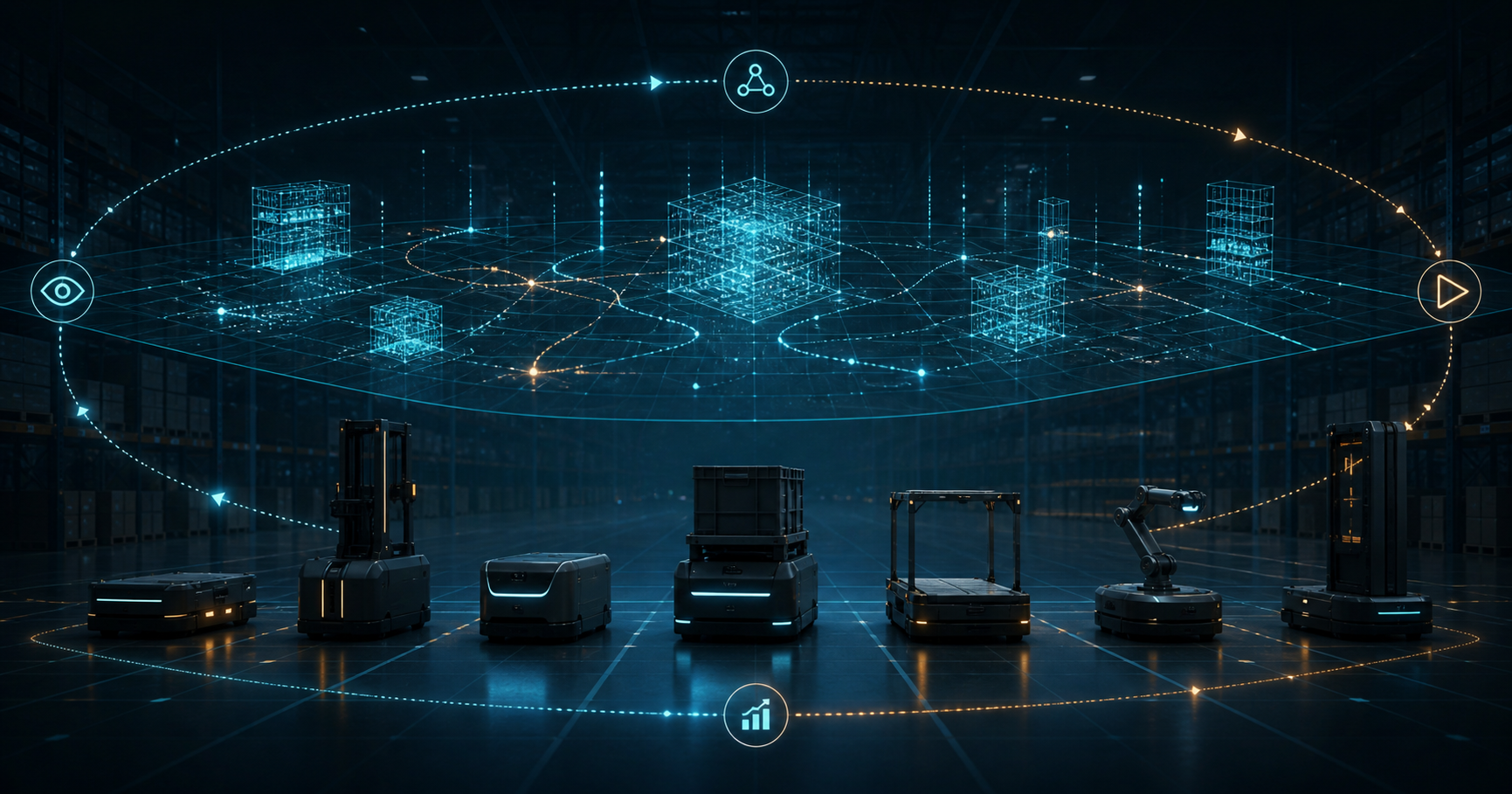
Traditional automation tends to be described bottom-up: machine → controller → fleet manager → WMS
A software-defined warehouse is better understood top-down: business outcome → operating model → orchestration → physical execution
The machine still matters. Payload, kinematics, charging behavior, navigation, safety limits and observability remain physical facts.
But they increasingly become capabilities consumed by a higher operating layer.
3. QAVEN’s next question: can the vessel be replaceable?
An integrated robotics company can tightly couple hardware and software. That has real advantages: fewer interfaces, clearer responsibility and strong co-design between machine behavior and orchestration.
QAVEN is testing a different architecture.
The operating model should persist even when compatible physical resources change underneath it.
That means separating four things that are often fused together:
- Physical capability — what a resource can safely do.
- Deterministic execution — how missions, traffic, charging, exceptions and policies are executed.
- Operational intelligence — what should happen given business goals and warehouse context.
- Execution evidence — what actually happened, under which conditions, and how that changes the next decision.
This is why vendor independence cannot mean a thin lowest-common-denominator API.
Hardware-agnostic must never mean hardware-indifferent.
The execution layer still needs deep knowledge of capability, state, constraints and behavior.
4. Complexity underneath. Simplicity above.
Multi-vendor automation creates an obvious danger: the customer could end up with more complexity, not less.
Different vendors expose different mission models, error states, firmware behavior, charging semantics and telemetry. A software layer that merely exposes all of that through another interface has not solved the problem.
The design principle should therefore be:
Complexity underneath. Simplicity above.
QAVEN Core is intended to absorb the heterogeneous execution details into canonical capabilities, state and mission contracts.
SEMANTIQ can then reason over a stable operational model instead of reasoning directly over vendor-specific robot APIs.
The customer should see business intent, current state, constraints, evidence and exceptions — not the integration history of every machine on the floor.
5. From fleet data to an operational evidence loop
Exotec’s fleet-data point is especially important.
A proprietary fleet can build a valuable dataset around one controlled machine family.
A vendor-independent layer has the potential to build a different asset: normalized operational evidence across vendors, enterprise systems, sites, processes and simulations.
For QAVEN, that suggests an explicit cross-cutting evidence substrate across Core and SEMANTIQ. It should capture and connect:
- robot telemetry and mission outcomes;
- WMS/WES events, orders, inventory and SLA context;
- station and operator interventions;
- capability declarations and conformance evidence;
- simulation scenarios and predicted outcomes;
- failures, recoveries and policy versions;
- optional perception-derived observations.
The moat is not a large database.
The useful asset is the relationship between: capability claim → operating context → decision → execution → observed outcome.
That evidence can make the next deployment, simulation and operational decision better.
6. Cameras create a pre-robot wedge
The camera thesis has another consequence.
A customer does not need to own an AMR fleet before a warehouse becomes observable.
Existing process data, WMS history, manual sampling and — where appropriate — existing CCTV or a temporary camera kit can create an initial physical-work baseline.
That suggests a sequence that starts before automation procurement:
Observe
Build evidence about flows, queues, stations, bottlenecks, resource use and uncertainty.
Simulate
Compare human, hybrid and robotic architectures; test resource counts, layouts, policies, charging, congestion and failure modes.
Execute
When the process and pilot are ready, QAVEN Core validates and executes across supported physical resources.
Optimize
Compare predicted and observed outcomes, update conformance confidence, recalibrate the World Model and test the next change.
Observe → Simulate → Execute → Optimize
This turns readiness into a possible product interaction rather than a consulting prelude to the “real” software.
One guardrail matters: operational cameras are an observation layer, not a replacement for certified robot safety or navigation sensing.
7. Exotec validates the direction — and raises the bar
Exotec is not evidence that an independent orchestration architecture will automatically win.
In fact, its integrated model demonstrates the opposite pressure: tightly integrated hardware and software can be extremely effective.
The relevant competitive question is therefore not: Who has better robots?
It is: Where does the persistent operating model live, and can it remain physically deep while becoming vendor-independent?
QAVEN only creates meaningful differentiation if it can preserve performance, capability awareness, execution reliability and learning without collapsing into a generic middleware layer.
That is a harder problem than supporting multiple APIs.
8. What changes for QAVEN
Make the evidence substrate explicit. Observation, simulation, conformance, execution and evaluation need a shared evidence substrate.
Productize the closed loop. Observe → Simulate → Execute → Optimize should be one product spine, not four disconnected service modules.
Use perception carefully. Cameras can expand operational observability, especially before AMR deployment, but they should not blur the boundary between analytics and certified control.
Treat simplicity as a product metric. Multi-vendor depth matters only if QAVEN removes complexity from the customer-facing operating model.
Measure evidence, not adapter count. Supporting another robot matters less than knowing how its declared capabilities behave under real conditions and being able to reuse that knowledge.
9. What does not change
QAVEN should not interpret this thesis as permission to become a generic Physical AI lab.
The beachhead remains mobile intralogistics.
Core remains deterministic.
SEMANTIQ remains above a hard execution boundary.
Hardware remains physically important even when it is strategically replaceable.
And the company should not build proprietary robot hardware by default simply because integrated stacks can be powerful.
The goal is narrower:
Own the operational model and the evidence loop deeply enough that the physical execution substrate can evolve without resetting the warehouse intelligence above it.
Bottom line
Exotec’s Tesla analogy moves the center of robotics value toward software, data and continuous improvement.
QAVEN’s extension is one step further:
Exotec thesis: hardware becomes the vessel for software.
QAVEN question: what happens when the vessel itself becomes replaceable?
Our working answer:
Robots change. Operational intelligence persists.